
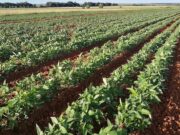
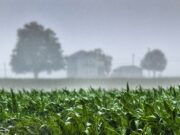


A verdant landscape, once painted a vibrant pink by tens of thousands of lesser flamingos, now stares back in bleak green. Kamfers Dam, once a vital African breeding ground for these majestic birds, has been abandoned, its waters rendered a toxic, bubbling sludge by years of relentless raw sewage discharge. The poignant absence marks a stark environmental tragedy, and a damning indictment of failing municipal infrastructure.
Until recently, this artificial dam outside South Africa’s historic diamond-mining town stood as one of only four known African breeding sites for the lesser flamingo, alongside two salt pans in Botswana and Namibia, and a soda lake in Tanzania. Now, it stands as a grim monument to neglect.
The lesser flamingo, though currently listed as “near-threatened” by the International Union for Conservation of Nature (IUCN) with an estimated two to three million individuals globally, is in steep decline. Four-fifths of the population reside in Africa, the rest in South Asia. However, the poisoning of Kamfers Dam has dramatically worsened their precarious plight.
Tania Anderson, a conservation biologist specialising in flamingos, revealed to Reuters that the IUCN is on the cusp of reclassifying the lesser flamingo as “vulnerable,” signifying a “high risk of extinction in the wild.” This grim re-evaluation is largely attributed to the shrinking and degradation of their specific habitats – shallow, salty estuaries or soda lakes critical for their unique feeding habits.
“It’s really very upsetting,” Anderson lamented, reflecting on the ongoing sewage spills. “Flamingos play a pivotal role in maintaining the water ecosystems of our wetlands.” Her words underscore a broader, disturbing trend: a 2021 study in Biological Conservation found that sewage poses a threat to aquatic ecosystems across vast swathes of the planet, a crisis that went unresolved at last year’s UN COP16 biodiversity summit in Colombia.
“They Just Disappeared”
Footage from May 2020, captured by the Wildlife and Environment Society of South Africa, depicts Kamfers Dam a kaleidoscope of pink, teeming with flamingos. This month, a visit by Reuters revealed a desolate scene: not a single flamingo remained. A closer inspection of the water revealed a putrid green sludge, reeking unmistakably of human waste.
“It was a sea of pink,” recalled Brenda Booth, as she surveyed the bird-free lake on her farm, where acacia trees and antelope now stand witness to the ecological disaster. “They all just disappeared.” Booth, a tenacious landowner, recently secured a crucial court order compelling the African National Congress (ANC)-run municipality governing Kimberley, a city of 300,000, to rectify the environmental catastrophe.
Adrian Horwitz, the lawyer spearheading the case in the High Court of South Africa, Northern Cape division, painted a grim picture of the treatment plant’s decline. “Over the years, the treatment plant became progressively dysfunctional to the point where… approximately 36 megalitres a day of untreated sewage was being discharged into the dam,” he stated.
Thapelo Matlala, the municipality manager, attributed the plant’s demise to rampant vandalism and equipment theft, which brought it to a grinding halt. “We are working on a new strategy for… repairing the damage,” he told Reuters outside his office, but conceded that the necessary R106-million for repairs was simply not available to the cash-strapped council.
The widespread failure to deliver essential services, including sanitation, was a significant factor in the ANC’s recent loss of its 30-year-strong majority in last year’s elections, highlighting a systemic crisis permeating local governance.
Lesser flamingos are highly selective feeders, relying predominantly on spirulina, a blue-green algae, which they filter through their specialised beaks. This dietary requirement confines them to alkaline water bodies, predominantly found in East Africa’s Rift Valley. Their breeding habits are equally particular, with only three remaining sites in India, complementing the now-dwindling three in Africa.
Flamingos first began breeding at Kamfers Dam in 2006, a phenomenon documented by Ester van der Westhuizen-Coetzer, a wetlands specialist for local diamond miner Ekapa Group. She recounted how, in 2020, the dam hosted a staggering 71,000 flamingos, with up to 5,000 new chicks emerging each season.
“They’ve missed three or four breeding seasons,” she grimly observed, adding that many birds also succumbed to botulism, a disease that thrives in the very waste now polluting their former sanctuary.
The tragic plight of Kamfers Dam’s flamingos is, according to Van der Westhuizen-Coetzer, a microcosm of a much larger national crisis. Sewage contamination has become a pervasive problem across South Africa, with alarmingly few treatment plants remaining operational. If decisive action is not taken, she warned, “the whole system will degrade and blow up. That will have a huge impact, and not only on flamingos.”