



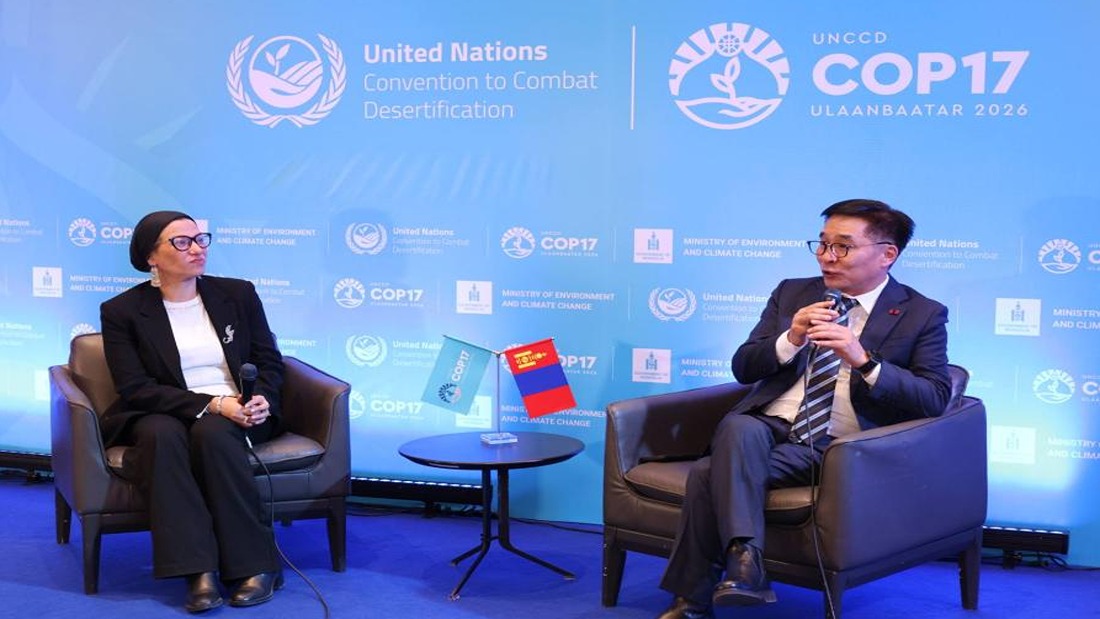
The future of food production is being debated in Ulaanbaatar this week, but the conversation is reaching far beyond farms and fields. At the heart of the UNCCD COP17 negotiations is a resource that agriculture cannot replace once it is badly damaged, productive land.
Delegates from 196 countries and the European Union are meeting in Mongolia as governments, investors, businesses, scientists and land users grapple with the growing economic consequences of degraded soils, shrinking water availability and increasingly severe drought. The numbers offer little room for complacency. Land degradation and drought are estimated to cost the global economy almost US$900 billion every year, while up to 40% of the world’s land is already degraded. The damage reaches an estimated 3.2 billion people, many of them dependent on agriculture, livestock and other land-based livelihoods.
Drought has become an equally costly threat. According to the UN Convention to Combat Desertification, droughts have increased by almost one-third since 2000 and now result in at least US$300 billion in losses annually. What makes the discussion in Ulaanbaatar particularly important for food producers is the growing recognition that drought and degraded land are not simply environmental problems to be managed after the damage is done. They can determine whether crops reach harvest, whether grazing remains available and whether rural households can withstand another difficult season.
UNCCD Executive Secretary Yasmine Fouad said healthy land underpins food systems, economies and social stability, arguing that the priority now must be to take solutions that already exist and expand them. “The world does not lack solutions but the challenge is taking them to scale,” said Fouad. That scaling-up, however, requires money.
The UNCCD estimates that US$355 billion is needed every year to address land degradation and drought, yet only about US$77 billion is currently being invested. The resulting US$278 billion annual shortfall puts the spotlight firmly on the private sector, which currently accounts for only about 6% of global finance flowing into land restoration and drought resilience. The conference is consequently looking beyond traditional public funding. Its Business4Land Forum on 24 August will bring companies, governments and investors together to examine ways of making investment in regenerative landscapes more attractive, while participating organisations in the Action Agenda on Regenerative Landscapes have already committed more than US$9 billion across over 210 million hectares.
That shift could prove significant for agriculture. Restoring soil, improving water retention, protecting grazing areas and rebuilding degraded landscapes require sustained investment, but they also protect the productive base on which farming and livestock businesses depend. Rangelands are receiving particular attention during the International Year of Rangelands and Pastoralists. Covering 54% of the Earth’s land surface, they support about two billion people, provide roughly 70% of livestock feed and account for one-sixth of global food production.
Yet up to half of the world’s rangelands are degraded or at risk. Mongolia provides a stark illustration of what that vulnerability can mean. Almost 77% of the country’s land is considered degraded, while pastoralism supports the livelihoods of one in three Mongolians. Severe drought followed by harsh dzud winters in 2023 and 2024 contributed to the loss of more than seven million livestock. The crisis also brings the conversation closer to where land decisions are actually made.
During COP17, around 30 mayors, governors and other local leaders adopted the Ulaanbaatar Declaration, calling for cities and regions to have a stronger role in land management, drought preparedness and access to finance. The declaration recognises that national commitments ultimately have to translate into decisions over water, land use, infrastructure and community resilience at local level. Agriculture sits directly within that equation.
A farmer cannot negotiate with a drought, and a livestock producer cannot restore a depleted grazing area overnight. The investments made before the next crisis in healthy soils, reliable water systems, resilient rangelands, early-warning mechanisms and better land management, can determine how severely that crisis is felt. COP17 runs until 28 August, with governments expected to take decisions on drought resilience, rangelands, agricultural land and soils, finance and private-sector participation.