




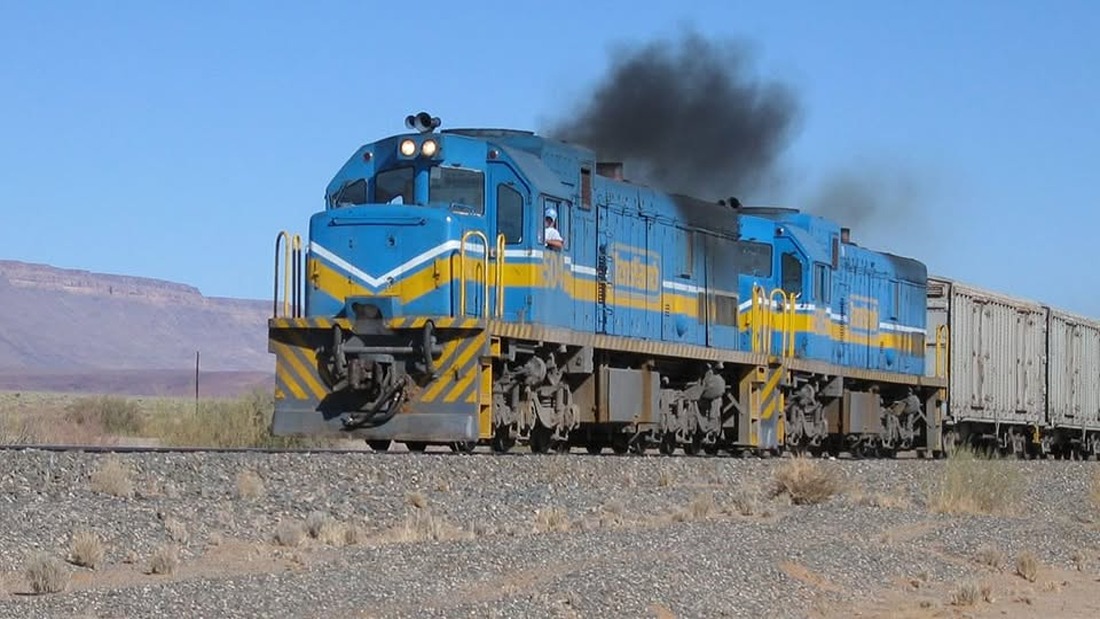
Government targets 1,000km of upgraded railway and 2,300km of gravel roads converted to bitumen standard. Namibia is putting rail at the centre of its transport infrastructure strategy, committing N$952.1 million to the railway network in 2026/27 as government seeks to improve freight movement and strengthen the country’s position along regional trade corridors.
The allocation gives rail the largest share of the Ministry of Works and Transport’s transport infrastructure programmes, exceeding the N$771.4 million earmarked for roads. The scale of the investment reflects a broader push to address the condition and reliability of Namibia’s rail network while advancing the Railway Master Plan and positioning rail as a more effective component of the country’s logistics infrastructure.
Ministry Director for Administration Moses Matatias told members of the National Council that railway development remains a flagship government programme, with implementation being undertaken through TransNamib. “The second programme under the Department of Transport is the Provision and Upgrading of the Railway Network. This is the Ministry’s flagship programme and receives the largest allocation. The programme has been allocated N$952 million for the current financial year,” said Matatias.
Of the N$952.1 million allocation, N$946 million will go towards development activities, with N$6.1 million allocated to operational expenditure. Government’s immediate target is to upgrade 1,000 kilometres of railway infrastructure during the 2026/27 financial year, with the target rising to 1,360 kilometres by 2028/29. The programme also provides for the maintenance of 1,600 kilometres of railway lines annually, highlighting the government’s focus not only on expanding or upgrading the network but also on keeping existing infrastructure operational and reliable.
The financial commitment is expected to remain substantial over the medium term. Rail funding is projected to increase to N$1.17 billion in 2027/28 before moderating to N$1.08 billion in 2028/29. Government is simultaneously working to strengthen the regulatory architecture underpinning the sector, targeting completion of 28% of the Railway Master Plan and an 80% review of primary railway legislation. Taken together, the infrastructure and policy targets point to an attempt to create a more coherent rail system capable of supporting Namibia’s evolving logistics requirements.
The rail investment forms part of approximately N$1.72 billion allocated to road and railway infrastructure programmes in 2026/27. Roads remain a major component of the strategy, with N$771.4 million allocated to the sector, including N$764.4 million for development expenditure. Government is targeting the upgrading of 2,300 kilometres of gravel roads to bitumen standard by 2026/27, while a further 725 kilometres of roads are earmarked for rehabilitation. The road programme also includes the construction of a weighbridge and a vehicle registration centre, alongside road safety interventions.
The significance of the infrastructure push extends beyond the condition of individual roads and railway lines. A more reliable transport network is increasingly important to the movement of minerals, agricultural products and other freight between production centres, ports and neighbouring markets. The government’s decision to place rail ahead of roads in the current transport infrastructure allocation therefore signals more than a capital spending priority. It points to an effort to reshape the country’s freight architecture around a network capable of supporting larger volumes of trade and improving Namibia’s role as a regional logistics corridor.