

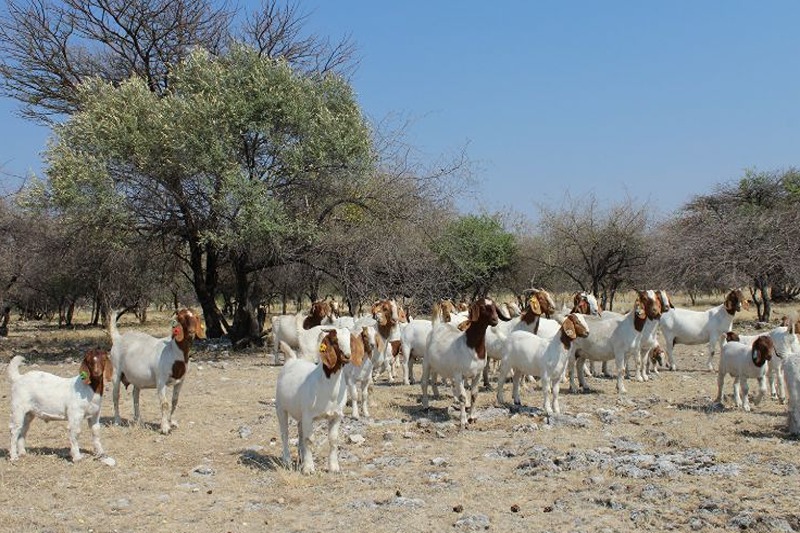
Namibia’s lucrative live Boer goat trade with South Africa is facing a growing profitability challenge, with export compliance and logistical costs now absorbing about 30% of the average auction value of each animal and leaving farmers with less from an already competitive market.
South Africa remains by far the most important destination for Namibia’s live Boer goats, with about 98% destined for the South African traditional market. The South African market provides an important and established outlet for Namibian farmers’ animals. However, the cost of accessing that market is increasingly putting pressure on producer margins, raising questions about whether the export process can be made more efficient without compromising animal health.
The Namibian Agricultural Union (NAU) states in its 7 August newsletter that every livestock producer understands the importance of animal health. Disease surveillance, testing and vaccination help protect Namibia’s livestock industry and keep important export markets open to its producers. To access the South African market, Namibian goat farmers must comply with South African animal-health import requirements, including testing for Brucella melitensis.
This comes at a cost, however. Exporting Boer goats is expensive and every additional compliance cost reduces the amount of money that ultimately reaches the farmer, putting further pressure on already limited profits. Laboratory testing is just one part of the process. Farmers also pay for blood sampling, veterinary services, transport, export documentation, feed and labour while goats are being prepared for export. The average cost of exporting a goat to South Africa is currently R485, about 30% of the average auction price.
The significance of these costs becomes clearer when viewed across the scale of the trade. More than 1.4 million goats have been exported to South Africa between 2016 and 2026, meaning even modest savings per animal could translate into meaningful additional income for Namibian producers. The issue is therefore not whether animal-health controls are necessary but whether the systems and protocols used to maintain those controls can be delivered more efficiently.
Namibia’s strong reputation for animal health remains one of the country’s greatest competitive advantages and must always be protected, the NAU says. However, it is equally important to ask whether existing import protocols remain the most effective and scientifically appropriate way to achieve that goal. Farmers operating on tight margins feel this significant distinction. If testing, certification, veterinary procedures and other export requirements can be streamlined without weakening disease-control measures, the resulting savings could improve producer returns while preserving Namibia’s access to the South African market.
With South Africa absorbing almost all of Namibia’s live Boer goat exports to the traditional market, improving the economics of this established trade could prove as important as finding new markets. The challenge now is to strike a balance between rigorous animal-health protection and an export system that remains commercially viable for the farmers who supply the trade. Reducing unnecessary or avoidable costs could strengthen producer profitability while helping Namibia maintain a competitive and sustainable Boer goat industry.