






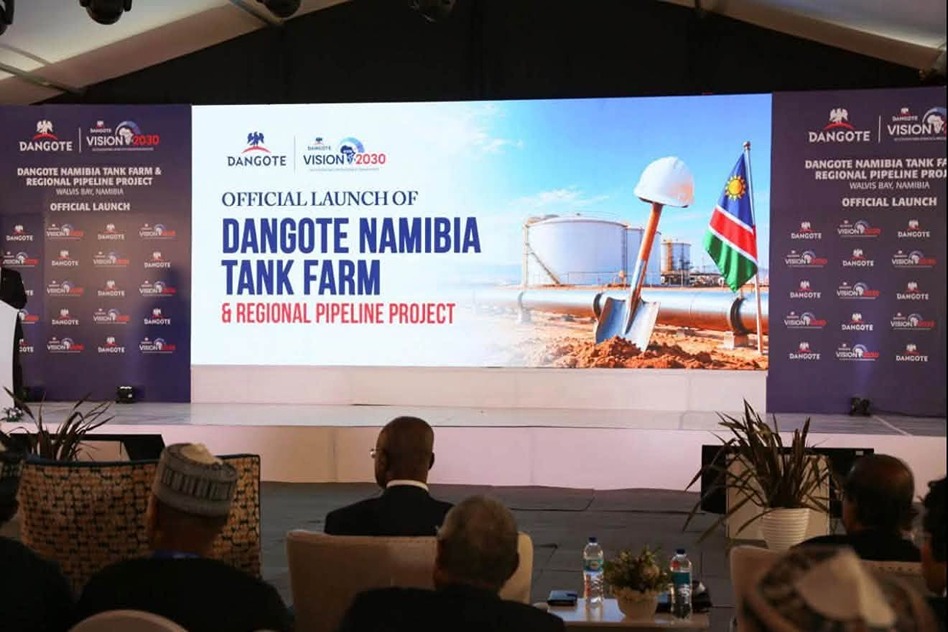
Can Namibia become a strategic energy gateway for landlocked Southern African economies? A planned US$2.5Bn fuel storage and regional pipeline project at Walvis Bay is designed to strengthen the country’s petroleum distribution capacity and open a new supply corridor for neighbouring markets.
Launched on 4 November 2026 by President Netumbo Nandi-Ndaitwah and Nigerian industrialist Aliko Dangote, the Dangote Namibia Tank Farm and Regional Pipeline Project will establish a fuel storage facility with planned capacity of about 600 million litres, equivalent to four million barrels, made up of 360 million litres of diesel and 240 million litres of petrol, along with truck loading, dispensing and associated distribution infrastructure. According to the project announcement, construction is expected to take 18 to 20 months.
A major component is a proposed regional pipeline network of about 1,700 kilometres, intended to connect Walvis Bay with inland distribution points and provide a supply route towards Botswana, Zambia, Zimbabwe, Malawi and parts of the Democratic Republic of Congo. For landlocked economies, reliable petroleum supply is vital, since fuel underpins transport, agriculture, manufacturing, mining and electricity generation. A regional storage and pipeline network could add supply options, reduce reliance on long distance road transport for bulk fuel and improve distribution efficiency. For Namibia, the project offers more than storage, with potential to support jobs, logistics services, port operations and related businesses around Walvis Bay, and it fits the country’s ambition to strengthen its position as a regional transport and logistics centre. It also reflects the widening regional ambitions of Dangote Industries Limited, which after building the Dangote Petroleum Refinery in Nigeria has continued to explore energy infrastructure and fuel distribution across African markets.
The project’s potential, however, depends on implementation. The pipeline network requires cooperation among several countries on routes, cross border operations, tariffs, supply arrangements and regulatory standards. Environmental and regulatory approvals are equally important. The Namibian reported on 9 November that the Walvis Bay terminal was still awaiting environmental clearance, a reminder of the gap between a launch and the approvals needed for full implementation. The economic benefits will also depend on how well the facility links with existing ports, transport operators and fuel distributors. Pipelines can improve the movement of bulk petroleum products but road transport will remain necessary to take fuel from distribution points to businesses, industrial users and filling stations.