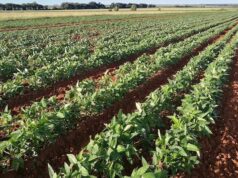

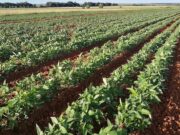



In a significant stride toward national food independence, the Ministry of Agriculture, Fisheries, Water and Land Reform (MAFWLR) is pressing forward with a large-scale irrigation initiative in the country’s arid north, culminating in the critical phase of drilling for a stable water supply. The 140-hectare Ekoka Irrigation Project, situated in the Ohangwena Region near the village of Okongo, aims to transform dormant communal land into a major agricultural center, creating jobs and bolstering the nation’s resilience against drought.
As of November 1, the ambitious engineering effort recorded a key success: the first exploratory borehole reached a depth of approximately 180 meters, successfully intersecting the upper Ohangwena-I aquifer at the 151-meter mark. This milestone marks a crucial step in fulfilling the project’s most pressing need: a reliable, long-term source of water.
The initiative directly addresses President Netumbo Nandi-Ndaitwah’s national mandate to aggressively boost domestic food production and fortify Namibia’s self-sufficiency. Ensuring a consistent water source was prioritized after geophysical investigations in August identified groundwater as the most practical and cost-effective option for the scheme’s sustainability.
Drilling operations, which commenced on October 28, are highly focused on the deeper, more prolific Ohangwena-II aquifer, which lies beneath the shallower formation. While the Ohangwena-I aquifer is encountered between 150 and 180 meters below the surface in this area, seismic data suggests the Ohangwena-II system is likely situated between 200 and 400 meters. The drilling team is advancing toward this target, with a maximum depth of 300 meters set for the operation, which is scheduled to continue until November 20, 2025.
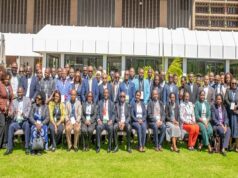
Ndiyakupi Nghituwamata, the ministry’s Executive Director, emphasized the government’s commitment during a recent visit to the site. “The government remains fully committed to transforming underutilised land into productive agricultural hubs,” she noted, highlighting the project’s dual purpose of job creation and improving local livelihoods in the region.
The Ekoka development forms a core component of the ministry’s broader strategy to ensure every one of Namibia’s regions contributes substantially to the national food basket. By strengthening community resilience and diversifying the nation’s agricultural output, the project seeks to move Namibia measurably closer to its goal of food self-sufficiency.